
Quick answer. Yes. When a dash cam runs on the vehicle's 12 V supply in parking mode, it uses battery charge while the vehicle is off. That can leave too little starting reserve after a cold night, especially if the battery was already weak or undercharged. A supported timer and voltage cutoff can limit the draw. If the problem repeats, verify how the camera is powered and have the battery, charging system and parked electrical draw checked. Thinkware parking-mode battery guidance · Subaru parasitic draw diagnostics, pages 3–8
What powers a dash cam after shutdown?
A camera on an outlet that switches off normally loses vehicle power when that outlet shuts down. On a timed outlet it may run a little longer. If the outlet stays live or you use a compatible constant power kit, the vehicle can keep supplying it while parked. A separate compatible dash cam battery pack can supply parked power from its own charge.
A typical three-wire hardwire kit has BATT for fused constant power, ACC for the switched signal that tells the camera the vehicle's state, and GND for ground. On kits that use ACC as the mode trigger, the camera can switch into parking mode when the signal drops while BATT remains live. Read the labels and instructions for the actual kit. Wire colours and switching behaviour vary. Garmin X110 owner's manual · Thinkware ACC and constant power troubleshooting
How much charge can parking mode use overnight?
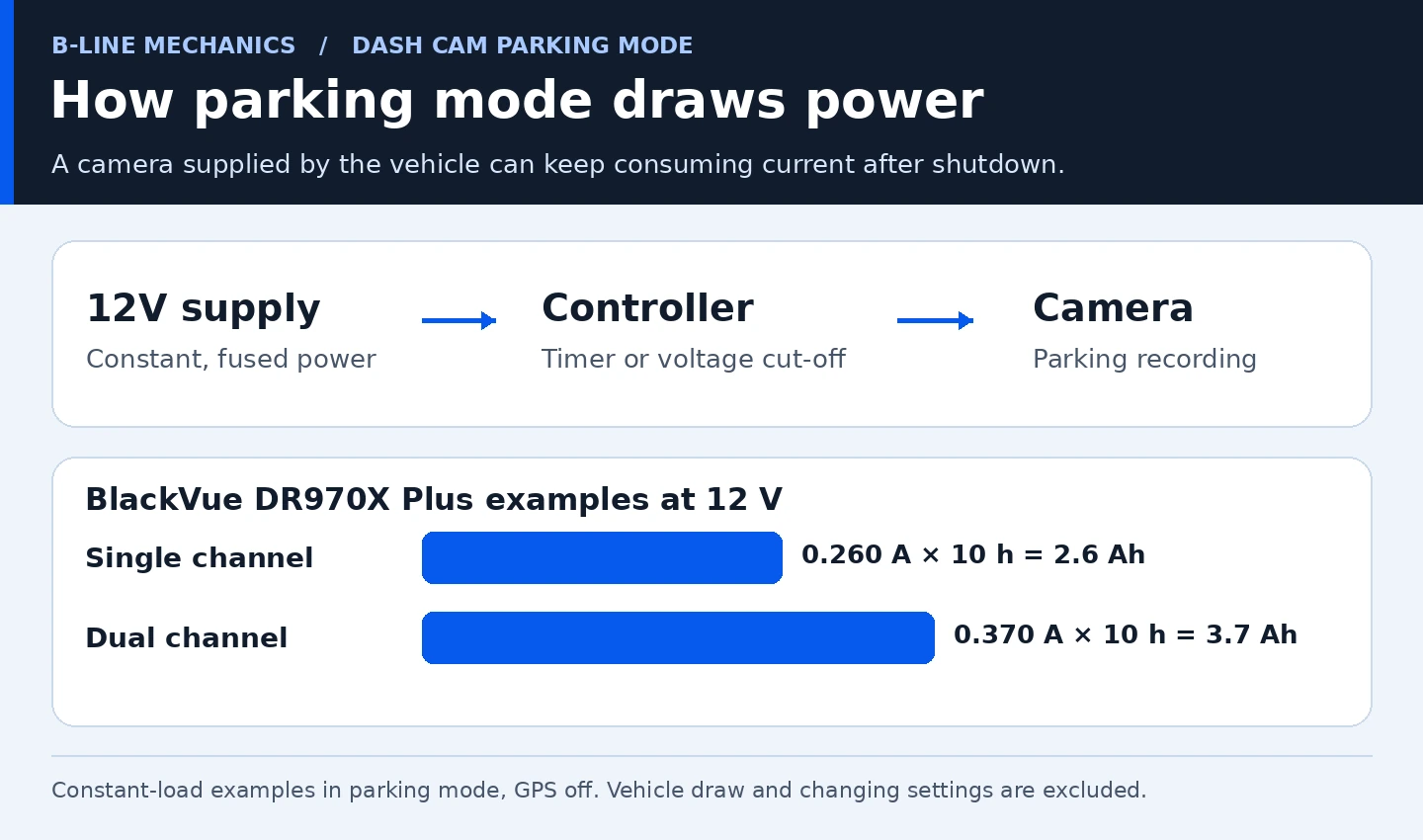
BlackVue publishes average draw for two DR970X Plus configurations in parking mode with GPS off. Multiplying current by hours gives an estimate of charge used at a sustained draw. BlackVue DR970X Plus specifications
| BlackVue example at 12 V | Average parking-mode current | Calculated charge for 10 hours at that average |
|---|---|---|
| DR970X-1CH Plus with GPS off | 0.260 A | 2.6 Ah |
| DR970X-2CH Plus with GPS off | 0.370 A | 3.7 Ah |
The estimates cover the camera only. The vehicle still has its own parked electrical loads. Recording settings, hardware and operating conditions also change the draw. In winter, a battery can deliver less starting power, and repeated short trips can leave it undercharged. Use the ten-hour calculation to compare camera loads. To assess starting reserve, check battery charge and condition under the vehicle's test procedure. Toyota Canada's 12 V winter battery guidance
Set the timer and cutoff for the hardware you have
A record timer limits operating time. A low-voltage cutoff is meant to stop the camera or its power adapter when measured voltage falls to the configured threshold under the device's rules. A shorter timer or earlier cutoff can preserve more starting reserve and shorten parking coverage. Some Thinkware units have a winter setting. Thinkware explains that the camera may miss the cutoff if the voltage is already below the threshold when parking mode starts. Follow the exact device instructions, verify that it shuts down as expected, and disable parking recording if you need to preserve starting reserve. Thinkware cutoff and winter settings
Garmin's video shows owners of compatible cameras where to configure Parking Guard and how its parked event recording works. Use it alongside the instructions for your camera and power adapter. Watch Garmin's Parking Guard setup.
What a technician checks after a repeat no-start
- Record the pattern. Bring the camera model, kit and settings, when the problem started, trip length and how long the car was parked. Mention a new remote starter, charger or other accessory. Note whether the starter turned slowly or the engine cranked normally without starting.
- Check the battery and charging system. Measure battery charge and condition, check the connections, and verify charging according to the vehicle's procedure. A successful boost tells you little about why the charge was low.
- Wait for the vehicle to go to sleep. Modules can draw more current when the key is nearby, a door is opened or a network is awake. The technician checks standby draw after the specified sleep conditions are met, logging long enough to catch intermittent wake-ups where needed.
- Isolate the load. Compare what changes when the camera circuit is isolated correctly. Examine its power and mode transition as well as other circuits if the draw continues. If the camera is a plug-in accessory, unplugging it while parked can provide a useful observation for the shop.
Subaru's diagnostic sequence for parked battery draw.
Questions about dash cam battery drain
Can a dash cam drain a battery in one night?
Yes, especially when battery charge is already low or the camera continues running beyond the intended cutoff. How much reserve you have depends on the vehicle, the battery condition, the weather and other parked loads.
Does a hardwire kit guarantee the car will start?
A compatible cutoff and timer can reduce the drain. Starting still depends on battery health and charge, temperature, and whether the kit and vehicle behave as configured. If the car still needs boosting, test the electrical system before relying on a different cutoff setting.
Can an aftermarket remote starter cause a similar problem?
A receiver or control module can draw current while the car is off. Mazda includes aftermarket remote starters among the devices to account for in its discharged-battery service guidance. If the problem started after installation, tell the technician so they can check that circuit and confirm the actual draw. Mazda service alert SA-031/24
Bring the accessory details and your parking pattern to B-Line Mechanics in Mississauga for battery and electrical diagnosis. For other electrical loads and cold-start choices, see our 12V car heater guide, block heater guide and winter service checklist.