
Quick answer. Installing new tires is a good time to check wheel alignment. Adjust angles that fall outside the vehicle's specification as its service procedure directs. A routine seasonal swap between two compatible sets of complete wheels does not by itself call for adjustment. Move the check up the list if the old tires wore unevenly, the steering wheel sits off-centre, the car pulls, or you recently hit a pothole. Michelin Canada on when to check alignment
Why the old tires tell you what to check
Before the shop disposes of your old tires, ask what the tread looked like across all four. Uneven wear can point to an issue worth investigating before it affects the new set. The inner edge is easy to miss when you look at a car in the driveway. It may be significantly more worn than the shoulder you can see.
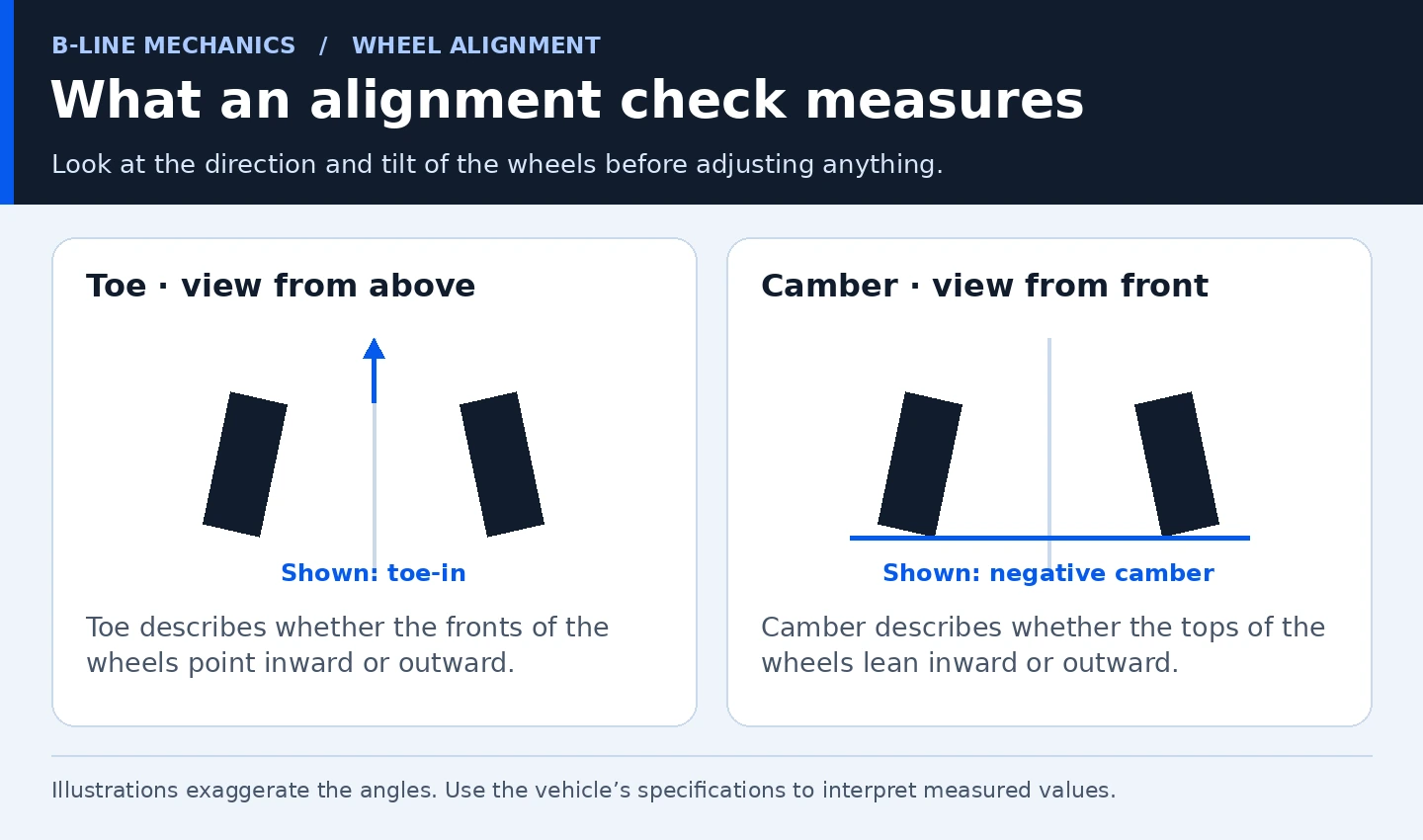
Alignment describes where the wheels point and how they tilt when the vehicle is sitting at the specified height. Toe is how far the wheels point inward or outward when viewed from above. Excessive toe can scrub the tread sideways and leave feathering, where adjacent tread blocks feel sharper in one direction. Camber is inward or outward tilt viewed from the front of the car. A camber issue can concentrate wear on one shoulder. Caster describes the tilt of the steering axis viewed from the side and influences steering feel and return. Tire pressure, suspension movement and usage can contribute to the same wear patterns. An inspection and measurement narrow the cause. Transport Canada on inspecting tire wear and alignment
| What you notice | What to check before or during installation |
|---|---|
| One shoulder worn much faster than the rest | Measure inner, centre and outer tread. Check steering and suspension play, tire pressure, and wheel angles. |
| Feathering across several tread ribs | Ask for toe measurements and check for suspension or steering movement. |
| Steering wheel off-centre or a persistent pull | Confirm the symptom on a suitable road and check pressure, tire condition and alignment. |
| Highway-speed shake after new tires go on | Start with tire and wheel condition, seating, balance and runout, which is how far an assembly varies from a true circle as it turns. |
| Even wear and straight tracking | A measurement gives you a baseline for the new set. Keep the printout if the readings are within specification. |
A new tire installation and a seasonal swap involve different work
Mounting new tires means fitting new rubber to wheels, then balancing the assemblies. The technician can check how the old set wore while it is coming off. That evidence gives context to the alignment readings and helps protect the new set.
On an ordinary swap, a compatible, already mounted wheel set goes on in place of the other one. The shop still needs to verify the tire and wheel fitment, condition and pressure. If the car drove straight before and the previous set wore evenly, the swap alone gives little reason to change the alignment settings. If the car pulls after the swap, identify which set causes the symptom and when it started. A tire itself can generate sideways force even when geometry is within spec. Road slope and incorrect inflation can also affect how the car tracks. Toyota's diagnostic bulletin on vehicle pull and tire forces
What should be on your alignment report?
The shop should select the specifications for your vehicle and setup. The technician checks tire pressure and condition, then looks for play, damage or ride-height issues that could make an adjustment unreliable. On the rack, the equipment measures the wheel angles, including the rear readings where applicable. Each adjustment depends on what the vehicle allows. If a reading is outside the range and an angle lacks a normal adjustment, the next step is to find out why.
Ask for the initial measurement and, if an adjustment was needed, the final reading. A report lets you see which angle changed and records a baseline for later wear. If the car still pulls with readings in range, ask what tire, wheel or road-test checks would isolate that symptom. GM's alignment procedures specify current vehicle data, prechecks, initial measurements, adjustment where necessary and a verification drive. GM wheel alignment bulletin, pages 7–9
Frequently asked questions
Should I check alignment before or after fitting new tires?
Show the technician the old tread first. If it shows unusual wear or an impact damaged a wheel, check for a fault before putting the new set into service. The final measurement should use the setup and preparation specified for your vehicle. The shop can coordinate mounting, repairs and alignment in the same visit when practical. Alignment after suspension work
Does balancing new tires also align them?
Balancing corrects weight distribution within the wheel-and-tire assembly. Alignment measures and adjusts wheel angles on the vehicle. If your main complaint is a shake or a pull, describing the speed and conditions helps us select the right check. Wheel alignment versus balancing
Can I fit new tires without adjusting a car that tracks straight?
Yes, if the relevant alignment readings are within specification and the vehicle has no other procedure that calls for work. A straight steering wheel is useful information, but it cannot show every toe or camber issue. Checking gives you numbers to compare with the actual wear.
Plan your new tires and alignment in Mississauga
When you contact B-Line Mechanics, tell us which tires you are fitting and whether the previous set showed uneven wear. If you have a recent alignment report, bring it along with any photos of the old tread. We can discuss whether to measure alignment, investigate a symptom or address worn parts before adjusting anything. Wheel alignment in Mississauga · Book an appointment