
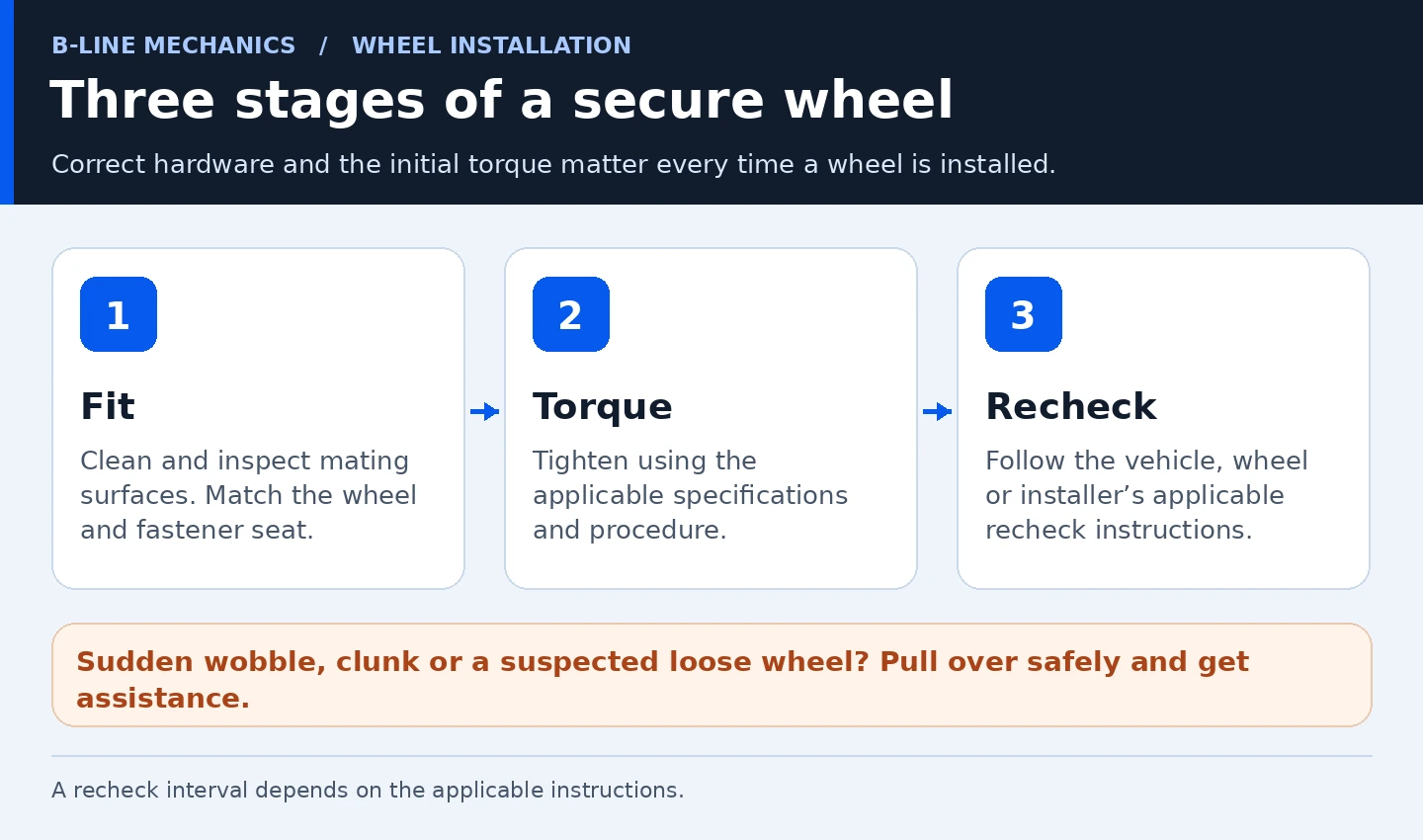
Follow the wheel torque recheck instructions for your vehicle and the wheels you just installed. Ask the installer when to return if your invoice leaves that unclear. The distance varies with the manufacturer and the wheel setup. If you hear a new clunk, feel a sudden wobble, or see a missing wheel nut, pull over safely and arrange assistance right away.
What does retorquing a wheel actually check?
The nuts or bolts clamp the wheel against its mounting surface. At installation, the technician checks that the wheel sits flat, the hardware fits, and the fasteners are tightened in the specified sequence with a torque wrench. A follow-up torque check verifies the fasteners after the wheel has been driven, where the procedure calls for one.
Think about what can happen on a Mississauga car that’s been through several winters. Rust or grit can build up where the wheel sits against the hub or brake rotor. A wheel that sits on debris instead of its mounting face may shift as that material compresses or breaks up. The clamp can then drop. Ford explicitly calls for clean mating surfaces because poor contact can allow the fasteners to loosen. Ford 2024 F-150 owner's manual, Wheel Nuts
What a technician checks before the wheels leave the bay
| Check | Why it matters |
|---|---|
| Wheel and hub faces are clean and the wheel sits flush | The clamp has to hold the wheel against the intended contact surfaces. |
| The nuts or bolts match the wheel and vehicle | The threads, seat shape and applicable engagement have to fit the assembly. Some winter wheels need different hardware from the summer set. |
| Final torque matches the applicable specification | Under-tightening can leave insufficient clamp. Over-tightening can damage fasteners or threads. |
| The customer has the recheck instructions | The follow-up distance and procedure depend on the setup. Confirm them before you leave. |
The first three checks matter at installation. A later torque check cannot correct a wheel that was fitted with the wrong hardware. If the installer finds a fastener that has backed off or a wheel that shifts, we want the cause checked, including the wheel seats and threads, before the car goes back into service.
If you change wheels yourself, use the instructions for your exact vehicle and wheel. That includes whether the threads or contact surfaces need to be dry or prepared in a prescribed way. An impact wrench setting and the force you can apply by hand both vary. Use a suitable torque wrench and the specified sequence for the final tightening. Ford wheel installation guidance
How many kilometres after the swap should you recheck?
A 2025 Hyundai Palisade manual for the U.S. market calls for a check after driving over 50 km when tires are replaced, with another check after 1,000 km. Ford's Canadian-market 2024 F-150 manual calls for retightening within 160 km after a wheel disturbance, such as a rotation or wheel removal. Use those figures to see why the advice varies. For your vehicle, check its manual, any instructions for aftermarket wheels, and the guidance from your installer. Hyundai changing tires instructions · Ford F-150 wheel nut instructions
The same question applies to an on-rim swap, an off-rim change that involves wheel removal, a rotation and a spare tire installation. Any time a wheel comes off the vehicle, ask what follow-up the installation calls for. If you’re comparing a seasonal swap with having loose tires mounted, bring a photo or tell us which set you have. Tires and seasonal swaps at B-Line Mechanics
What if the car shakes just after its tire change?
Treat a sudden wobble, a new rhythmic clunk, or a visible loose or missing fastener as a possible wheel security problem. Get to a safe place and stop. Call the installer or roadside assistance and describe what changed. A scheduled recheck is for a correctly installed wheel with no symptoms.
Once wheel security has been confirmed, a technician can check for packed snow in the rim, a bent wheel, a tire defect or an out-of-balance assembly. Tell the shop the speed at which the shake starts, whether you feel it in the steering wheel or seat, and whether it appeared immediately after the swap. Those details help us reproduce the problem and decide where to look first. How alignment and wheel balancing address different symptoms
Frequently asked questions
Do both steel and alloy wheels need a torque recheck?
Use the instructions for both setups. Steel or alloy describes the wheel material. Fitment, fasteners, seat design and the vehicle or wheel maker’s procedure determine the installation and follow-up.
Is more torque safer if I’m worried about a loose wheel?
Use the applicable torque specification. If a wheel was driven loose, have the assembly checked for damage to the hardware and mounting seats. For suspected looseness or visible damage, arrange assistance.
Do I need to bring my locking wheel nut key?
Bring the key if the wheels use locks. Also bring the hardware supplied for the winter wheels if it differs from the summer set. Tell the shop if one key or fastener is missing so it can plan the work.
Confirm the recheck when you book
For a seasonal swap in Mississauga, tell B-Line which wheels you’re bringing and ask when to have their torque checked again. If the swap already happened, have the invoice and approximate kilometres driven since the work handy when you call. Book an appointment at B-Line Mechanics